


Adeno-associated virus (AAV) vector manufacturing is a critical step in advancing gene therapies from research to clinical application. However, AAV process development and scale-up present significant technical and regulatory challenges. From upstream production to downstream purification and GMP readiness, developers require robust, scalable processes to ensure product quality and regulatory compliance.
AAV Vector Manufacturing: From Process Development to GMP Readiness

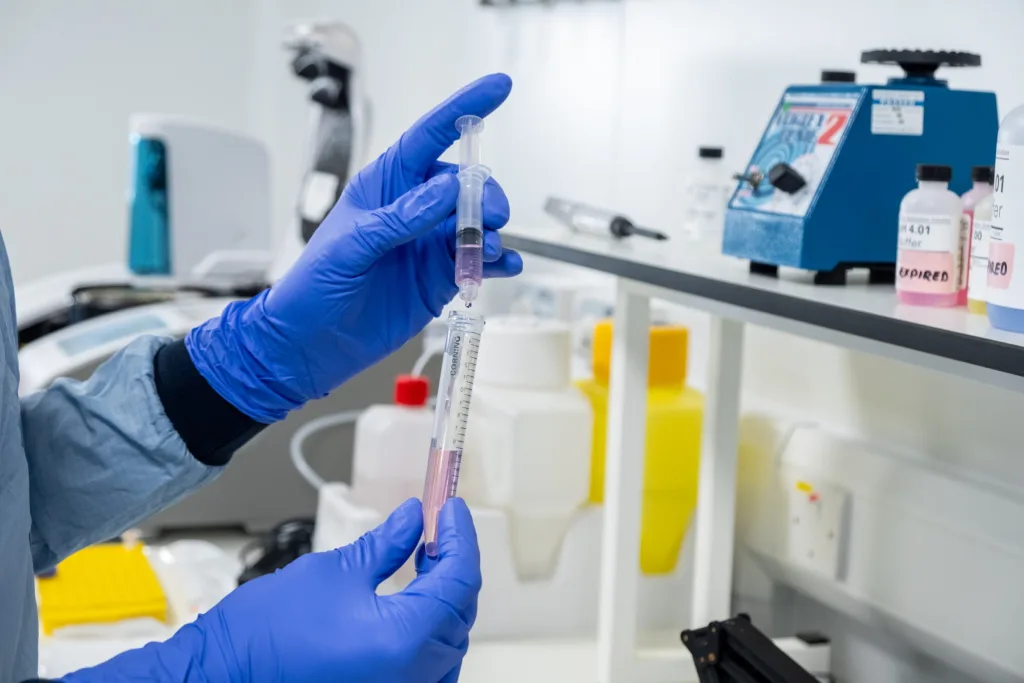
Challenges in AAV Vector Manufacturing and Scale-Up
AAV therapies hold remarkable potential for treating genetic disorders, but their development remains complex. Each serotype behaves differently; processes that work at small scale often falter when scaled up; and the regulatory expectations for viral vector production are evolving rapidly.
At eXmoor Pharma, we help gene therapy developers overcome these challenges with a clear, strategic approach to AAV process development. Whether you’re translating early research into a GMP-ready process or refining an established platform for clinical supply, our team combines 20 years of consultancy heritage with hands-on vector development expertise to move your therapy forward, faster.
We don’t just develop processes — we design them with the end in mind.
Our AAV team supports clients from preclinical concept through to GMP readiness, combining upstream, downstream, and analytical expertise within one facility. Our goal is to develop processes that are scalable, reproducible, and ready for seamless technology transfer into GMP manufacture.
Our capabilities include:

Choosing the Right AAV CDMO Partner
AAV developers face a crowded CDMO landscape, where many offer similar services but few combine consultancy-led insight with end-to-end delivery. Choosing the right partner can mean the difference between scalable success and costly rework.
Common pain points we help solve include:
- Uncertain scalability – processes that perform well at research scale but lose yield or quality during transfer.
- Product-specific complexity – novel serotypes, capsids, or payload designs can introduce challenges that standard platform approaches do not fully address.
- Analytical uncertainty – more complex AAV products may require deeper product characterisation and fit-for-purpose analytical strategies.
- Fragmented service models – disconnected PD and GMP teams that slow progress and risk data loss.
- Limited flexibility – rigid CDMO platforms that restrict development options or retain IP.
- Regulatory complexity – evolving standards that demand foresight and compliance planning.
At eXmoor Pharma, we address these challenges through a uniquely integrated model that brings consultancy, process development, analytics and GMP manufacturing together as part of one seamless workflow. This ensures clarity, speed, and technical continuity from early design to clinical delivery.
Expert Insights
Why early CMC input matters in AAV development
In this video, Clare Blue, Senior CMC Consultant, outlines how early CMC involvement helps developers think beyond initial proof of concept and define a strategy that considers manufacturability, product quality, scalability, packaging, and supply requirements from the outset.
For complex AAV therapies, these factors can vary significantly between products, so involving CMC expertise early can help identify risks sooner and reduce the likelihood of costly changes later in development.
An early warning sign in AAV scale-up
Daphné Bocciarelli, Head of Vector, shares one of the earliest warning signs that an AAV programme may struggle to scale as intended.
In this video, Daphné explains why variability can be an important early indicator of future scale-up challenges, whether that appears in titres, empty:full ratios, impurity profiles, or product stability. She also highlights the importance of understanding whether that variability comes from the process and can be improved, or whether it reflects product-specific behaviour that may present a more fundamental challenge during development.
You can view further insight about AAV process development, manufacturability, analytics, scale-up, and GMP readiness in our “AAV Process Development Expert Q&A Series” on our YouTube channel.
In this video series, Clare Blue, Senior CMC Translation Consultant, and Daphné Bocciarelli, Head of Vector, share practical perspectives on the challenges AAV developers face as programmes move from early design towards clinical manufacture.
What sets us apart:
Testimonials
Our Case Studies

Building a CMC Roadmap for an AAV-targeting Platform
Developed a strategic CMC roadmap for Tavira’s AAV-targeting platform, aligning internal teams and investors around clear priorities for clinical development.

Streamlining AAV Manufacturing for Clinical Scale-Up
Achieved GMP compliance through advanced optimisation, significantly enhancing yield and accelerating clinical readiness for a European biotech client’s AAV gene therapy.

Frequently Asked Questions
Find answers to common questions about AAV process development.
-
What is AAV and how is it used in gene therapy?
-
AAV, or adeno-associated virus, is a small virus widely used in gene therapy to deliver therapeutic genetic material into target cells. In gene therapy development, AAV vectors are engineered to carry a therapeutic gene or other genetic sequence that may help address the underlying cause of disease. AAV is widely used because of its clinical track record, tissue targeting potential, and suitability for a range of in vivo gene therapy applications.
-
How do AAV vectors deliver genetic material into cells?
-
AAV vectors are designed to carry therapeutic DNA into target cells, where that genetic material can, for example, support production of a functional protein or another intended therapeutic effect, depending on the product design. In practice, successful delivery depends on both the biology of the vector and the way the product has been developed, including capsid selection, the therapeutic sequence itself, and the target tissue.
-
Why is AAV widely used in gene therapy development?
-
AAV is one of the most established gene therapy platforms because it offers several important advantages:
- low pathogenicity
- tissue targeting potential through different serotypes and capsids
- a strong and growing clinical track record
- the potential for sustained gene expression
- broad relevance across multiple therapeutic areas
Its versatility has made AAV a leading platform in gene therapy development, although that does not remove the manufacturing and analytical challenges that can arise as products become more complex.
-
Are there risks associated with AAV-based gene therapy?
-
Like all advanced therapies, AAV-based gene therapy carries risks that need to be carefully understood and managed. These can include immune responses to the vector, dose-related toxicities, variability in patient response, and challenges related to product quality and consistency. Careful vector design, product/process development, analytics, and clinical oversight are all important in supporting a well-controlled programme.
-
What are the main challenges in AAV manufacturing?
-
AAV manufacturing becomes more challenging as products move beyond established designs and into more complex development programmes. Common issues include maintaining product quality during scale-up, removal of empty or partial capsid impurities, achieving batch consistency, and developing suitable analytical methods to allow full product characterisation. These challenges can become even more pronounced when novel capsids or more complex vector designs are involved, making process robustness and product understanding increasingly important.
-
How does AAV vector design affect manufacturing and product quality?
-
AAV vector design has a direct influence on how a product performs during manufacturing. Factors such as capsid selection, genome structure, and payload size can affect yield, purification behaviour, packaging efficiency and impurity profile. In practice, this means that early design choices can have a significant effect on scalability and on how straightforward, or difficult, downstream manufacturing becomes.
-
What are empty and partial capsids in AAV manufacturing?
-
Empty capsids are AAV particles that contain little or no genetic material, while partial capsids often contain incomplete genomes. These are common product-related impurities in AAV manufacturing, and they matter because they can potentially impact potency, can be immunogenic, complicate product characterisation, and increase the burden on both purification and analytics. Managing capsid impurities is therefore an important part of AAV process development and GMP manufacturing.
-
Why is analytical strategy important in AAV gene therapy?
-
A strong analytical strategy is essential in AAV gene therapy because product quality cannot be managed effectively without the right level of product understanding. Analytics are used to assess potency, genome integrity, assurance of dose, capsid composition, and impurities, while also supporting process development and comparability during manufacturing changes. As AAV products become more complex, standard assays may not always provide enough insight, so a more tailored analytical approach may be needed to reduce development risk and support manufacturing readiness.
-
Why do engineered AAV capsids create manufacturing and analytical challenges?
-
Engineered AAV capsids can improve tissue targeting or help address biological barriers, but they can also introduce new manufacturing and analytical complexity. This is because modifications to the capsid may affect how the vector behaves during production, purification, and characterisation. In practice, engineered capsids may behave differently in purification, show altered stability and require more tailored analytical methods or reference standards than established serotypes. As a result, they often need a more product-specific development strategy rather than relying solely on standard platform approaches.
-
What are the latest advancements in AAV vector technology?
-
Recent advancements in AAV vector technology are focused on improving therapeutic performance while supporting more effective development and manufacturing strategies. These include:
- engineered capsids for improved tissue targeting
- immune evasion strategies
- dual-vector approaches for larger payloads
- improved analytical methods for product characterisation
- more robust and scalable manufacturing and purification platforms
These developments are expanding what AAV therapies may be able to achieve, but they can also increase demands on process development, analytics, and GMP readiness.
Ready to discuss your AAV strategy?
Whether you’re planning your first GMP batch or refining a platform for later-stage studies, we can help you translate, optimise, and scale your AAV process with confidence. Contact us to start your AAV development journey with eXmoor Pharma.